

As applications grow into distributed systems, handling transactions becomes much harder. A single workflow may span multiple services, databases, and queues, and if one step fails, your system can end up in an inconsistent state.
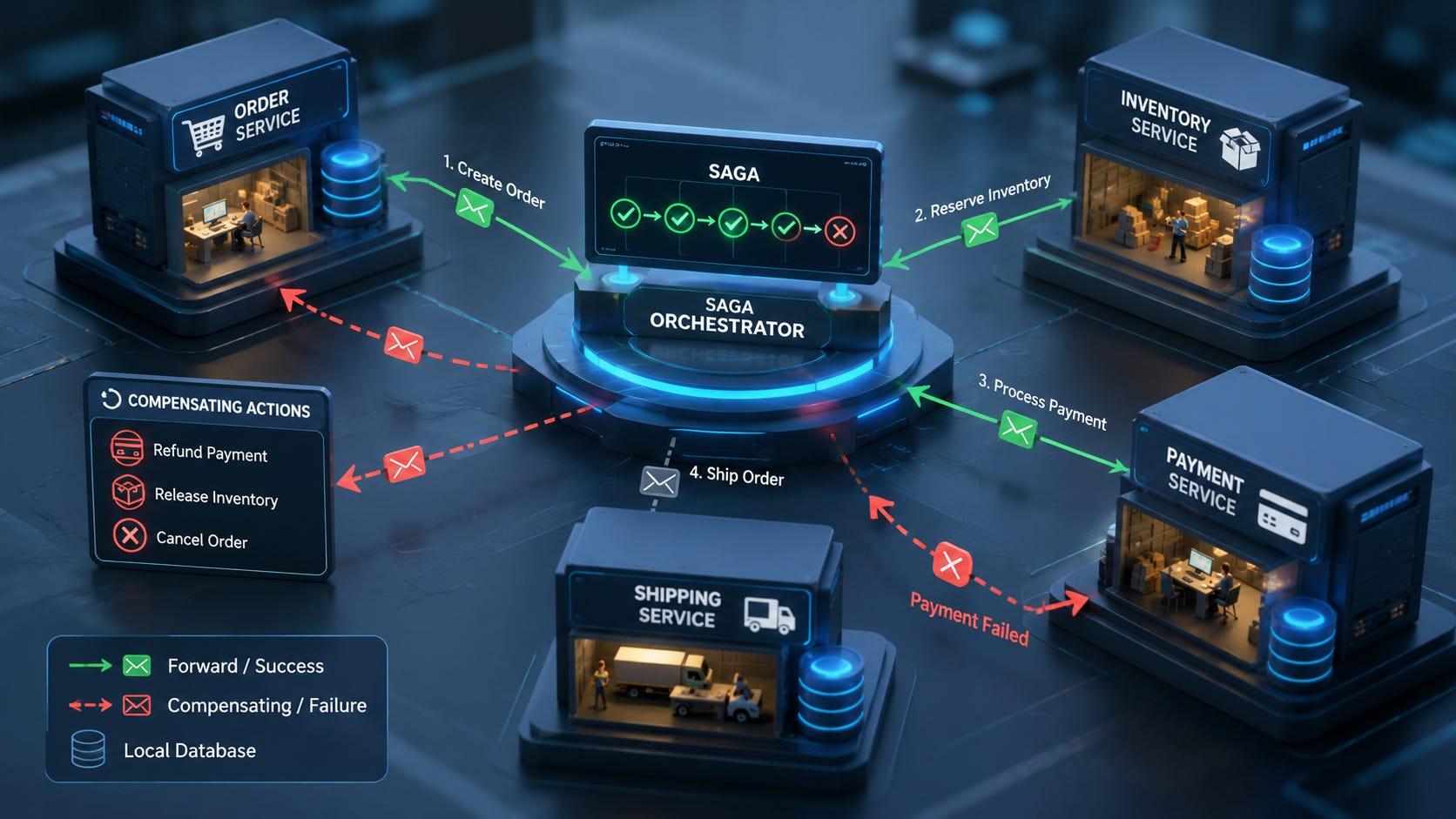
In this guide, we’ll explore how Saga patterns help ASP.NET Core applications manage distributed transactions safely, reliably, and at scale.
Why Distributed Transactions Become Difficult
In a traditional monolithic application, transactions are usually straightforward.
You wrap operations in a database transaction:
using var transaction = await _dbContext.Database.BeginTransactionAsync();

try
{
    await _dbContext.SaveChangesAsync();

    await transaction.CommitAsync();
}
catch
{
    await transaction.RollbackAsync();
}
Everything succeeds or everything rolls back.
Simple.
But modern systems rarely live inside a single database anymore.
Today’s applications often involve:
Multiple services
Independent databases
Message queues
External APIs
Now imagine this workflow:
Create an order
Reserve inventory
Process payment
Send confirmation
What happens if payment fails after inventory was reserved?
You can’t simply roll back everything with one database transaction anymore.
This is where Saga patterns become essential.
What Is a Saga Pattern?
A Saga is a way of managing distributed transactions across multiple services or modules.
Instead of one large transaction:
Each step completes independently
If something fails, compensating actions undo previous work
Think of it like a chain of small transactions working together.
Understanding the Core Idea
Imagine booking a vacation:
Reserve flights
Book hotel
Rent a car
If hotel booking fails:
Cancel the flight
Cancel the car reservation
You don’t rewind time. You perform compensating actions.
That’s exactly how a Saga works.
Why Traditional Distributed Transactions Don’t Scale Well
Older distributed transaction systems relied on protocols like Two-Phase Commit (2PC).
While powerful, they introduce:
Tight coupling
Performance overhead
Availability problems
Modern cloud-native systems prefer eventual consistency instead.
This aligns with many of the distributed architecture concepts we’ve explored earlier:
Saga patterns fit naturally into these systems.
Two Types of Saga Patterns
There are two common approaches.
Choreography-Based Sagas
In choreography:
Services react to events
No central coordinator exists
Each service listens for events and performs actions independently.
Example Flow
Order service publishes
OrderCreatedInventory service reserves stock
Payment service processes payment
Shipping service prepares shipment
Each service reacts automatically.
Benefits
Loosely coupled
Easy to extend
Natural event-driven design
Challenges
Harder to debug
Workflow becomes distributed
Complex flows become difficult to track
Orchestration-Based Sagas
In orchestration:
A central coordinator controls the workflow
The orchestrator decides:
What step runs next
What happens on failure
Which compensation actions execute
Example Flow
Saga Orchestrator
    ↓
Create Order
    ↓
Reserve Inventory
    ↓
Process Payment
    ↓
Ship Product
If payment fails:
Cancel Inventory Reservation
Cancel Order
Which Approach Should You Choose?
Smaller systems often start with choreography.
As workflows grow more complex, orchestration usually becomes easier to manage.
Most enterprise systems eventually lean toward orchestration because visibility and control become important.
Implementing Saga Patterns in ASP.NET Core
Let’s build a simplified orchestration example.
Step 1: Create Saga State
public class OrderSagaState
{
    public Guid OrderId { get; set; }

    public bool InventoryReserved { get; set; }

    public bool PaymentProcessed { get; set; }

    public bool ShipmentCreated { get; set; }
}
The Saga tracks progress across the workflow.
Step 2: Create the Orchestrator
public class OrderSaga
{
    private readonly InventoryService _inventoryService;
    private readonly PaymentService _paymentService;

    public async Task ExecuteAsync(OrderSagaState state)
    {
        try
        {
            await _inventoryService.ReserveAsync(state.OrderId);
            state.InventoryReserved = true;

            await _paymentService.ProcessAsync(state.OrderId);
            state.PaymentProcessed = true;
        }
        catch
        {
            await CompensateAsync(state);
        }
    }
}
Step 3: Compensation Logic
private async Task CompensateAsync(OrderSagaState state)
{
    if (state.PaymentProcessed)
    {
        await _paymentService.RefundAsync(state.OrderId);
    }

    if (state.InventoryReserved)
    {
        await _inventoryService.ReleaseAsync(state.OrderId);
    }
}
Compensation restores consistency.
Using Messaging Systems with Sagas
Most Saga implementations rely heavily on messaging systems.
This is where tools like:
Azure Service Bus
RabbitMQ
become important.
Messaging enables:
Reliable communication
Asynchronous workflows
Loose coupling
Saga Patterns with MassTransit
MassTransit provides strong Saga support for ASP.NET Core.
Official documentation
Install:
dotnet add package MassTransitConfigure MassTransit
builder.Services.AddMassTransit(x =>
{
    x.AddSagaStateMachine<OrderStateMachine, OrderState>();

    x.UsingInMemory((context, cfg) =>
    {
        cfg.ConfigureEndpoints(context);
    });
});
This simplifies orchestration significantly.
Long-Running Transactions
One major advantage of Sagas is handling long-running workflows.
Traditional transactions:
Hold database locks
Must complete quickly
Sagas:
Run asynchronously
Can span minutes or hours
This is critical in real-world distributed systems.
Eventual Consistency
Saga patterns embrace eventual consistency.
Instead of requiring every service to update instantly:
Systems become consistent over time
This is one of the biggest mindset shifts when building distributed systems.
Failure Handling in Sagas
Failures are normal in distributed systems.
Networks fail.
Services go down.
Messages arrive late.
Saga patterns are designed with this reality in mind.
Retry Strategies
Retries are commonly used before compensation.
Policy
    .Handle<Exception>()
    .RetryAsync(3);
Libraries like Polly help implement resilience.
This connects naturally to upcoming reliability topics in the series.
Idempotency Matters
Messages may be delivered more than once.
Your handlers must safely handle duplicate processing.
Example:
if (order.Status == "Processed")
{
    return;
}
Without idempotency, duplicate events can create serious issues.
Real-World Example: E-Commerce Checkout
A checkout workflow may involve:
Orders service
Inventory service
Payments service
Shipping service
If shipping fails after payment succeeds:
Refund payment
Release inventory
Cancel order
The Saga coordinates recovery automatically.
Sagas and Modular Monoliths
Saga patterns are not only for microservices.
They also work well inside modular monoliths.
Modules can:
Publish events internally
Coordinate workflows
Remain loosely coupled
This creates clean internal architecture.
Monitoring and Observability
Distributed workflows are harder to debug.
Tracking:
Which step failed
Which compensation executed
Current workflow state
Becomes essential.
Good logging and tracing are critical.
This prepares us perfectly for the upcoming observability topics later in the series.
Common Mistakes to Avoid
One common mistake is trying to make distributed systems behave like a single database transaction.
Another is forgetting compensation logic entirely.
Also avoid:
Tight coupling between services
Shared databases across services
Ignoring idempotency
When NOT to Use Sagas
Not every workflow needs a Saga.
Simple applications with:
One database
One service
Simple transactions
May not benefit from the added complexity.
Use Sagas when workflows become distributed and failure recovery matters.
How Saga Patterns Fit Your Architecture Journey
So far, you’ve learned:
How systems communicate
How APIs evolve
How modular architectures work
How distributed messaging operates
Saga patterns now connect all those pieces into coordinated workflows.
This is a major step toward designing resilient distributed systems.
Closing Thoughts
Distributed systems are powerful, but they introduce new challenges around consistency and failure handling.
Saga patterns provide a practical way to manage these challenges without relying on heavy distributed transaction protocols.
By combining:
Messaging
Compensation logic
Event-driven workflows
Eventual consistency
You can build scalable ASP.NET Core systems that remain reliable even when failures occur. Start simple, model workflows carefully, and design for failure from the beginning.
Join The Community
Enjoyed this article? Subscribe to ASP Today for practical ASP.NET Core insights and real-world architecture patterns. Join the Substack Chat and connect with developers building modern systems.